From Big Exploration to Learning Readiness
Welcome to one of the most exciting stages of your child’s development.
During the toddler years, your child learned through constant movement, curiosity, and exploration. Every question they asked, every object they touched, every game they played, and every conversation they shared helped build millions of important brain connections. In Phase 3, we called this Big Energy—the natural drive to explore and discover the world.
Now, something remarkable begins to happen.
Your child’s exploration starts becoming more intentional. Instead of simply experiencing the world, they begin making meaningful connections between what they already know and what they are learning. They start recognizing patterns, following directions, solving simple problems, expressing ideas more clearly, and participating with others in new ways.
This is the bridge between exploration and learning readiness.
The goal of this phase isn’t to rush your child into academics or expect perfection. Instead, it’s about strengthening the foundational skills that make future learning enjoyable, meaningful, and successful. Children who develop these skills gain confidence, independence, and the ability to approach new challenges with curiosity rather than frustration.
Independence doesn’t appear all at once. It grows one decision, one responsibility, and one small success at a time. Every opportunity to think, choose, and solve a problem helps prepare children for the challenges that lie ahead.
Throughout this phase, you’ll continue using the Little Step Framework’s simple, play-based approach. Learning happens during everyday routines, conversations, games, and shared experiences—not through pressure or long lessons. Small, consistent moments of engagement continue to produce the greatest growth.
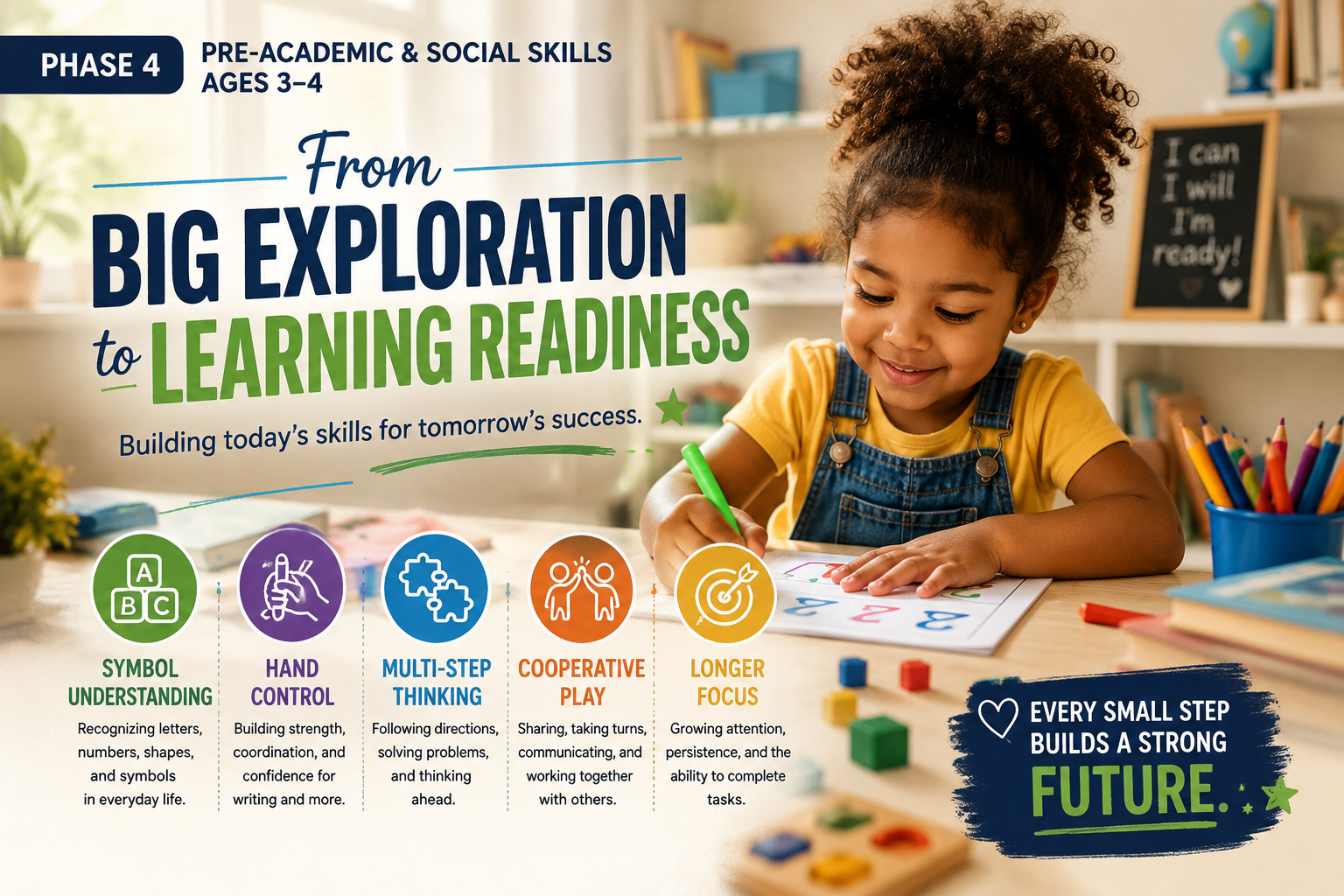
In this phase, we’ll focus on five essential areas of development that prepare children for preschool, kindergarten, and lifelong learning.
Symbol Understanding
Children begin recognizing that letters, numbers, shapes, and other symbols all carry meaning. They start connecting these symbols to words, ideas, and the world around them, laying the foundation for reading, writing, and early mathematics.
Hand Control
Fine motor skills become more refined as children strengthen the muscles needed for drawing, coloring, cutting, building, and early writing. Better hand control also supports independence in many everyday tasks.
Multi-Step Thinking
Your child begins following two- and three-step directions, remembering sequences, solving simple problems, and thinking ahead. These early executive functioning skills support learning, organization, and decision-making throughout childhood.
Cooperative Play
Play becomes more social. Children begin sharing ideas, taking turns, working together, and learning how to navigate friendships. These experiences help build communication, empathy, teamwork, and emotional understanding.
Longer Focus
As attention spans continue to grow, children become more capable of staying engaged in activities, completing simple tasks, and working through small challenges. Developing focus helps build persistence, confidence, and readiness for classroom learning.
Every Small Step Builds a Bigger Future
Every child develops at their own pace, and no two learning journeys look exactly alike. Some children will master certain skills quickly while taking more time with others—and that’s perfectly normal.
The purpose of this phase is not to compare your child to others but to provide meaningful opportunities for growth through encouragement, consistency, and connection.
By nurturing these five developmental areas, you’re helping your child build far more than early academic skills. You’re helping them develop confidence, curiosity, resilience, and a love of learning that will continue long after they enter the classroom.
From Big Exploration to Learning Readiness, every small step continues to build the foundation for a lifetime of learning