
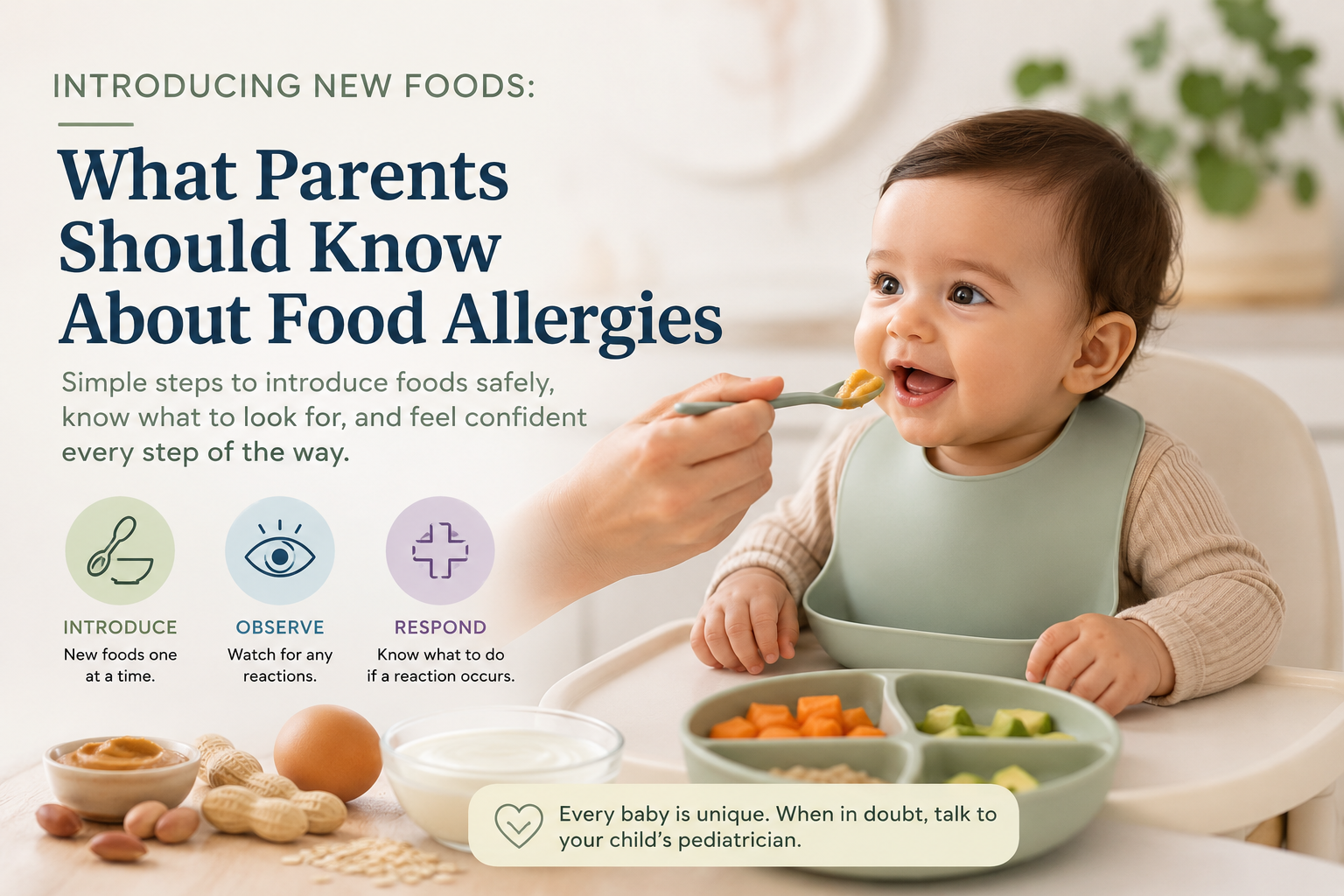
Introducing New Foods: What Parents Should Know About Food Allergies
Introducing solid foods is an exciting little milestone.
Suddenly, your baby is experiencing flavors, smells, colors, and textures they have never known before. You might get an enthusiastic smile after the first taste of banana—or a look that makes it very clear they would rather never see that spoon again.
Along with the fun, though, it’s completely understandable for parents to have questions about food allergies.
What foods should I introduce?
How will I know if my baby reacts to something?
Should I avoid foods like peanut or egg until my baby is older?
Learning what to look for can make this stage feel less intimidating.
Start When Your Baby Is Ready
Most babies are ready to begin trying foods other than breast milk or infant formula at around 6 months of age. Readiness matters more than simply reaching a date on the calendar.
Signs of readiness can include being able to sit with support and maintain good head and neck control, bringing objects toward the mouth, and swallowing food rather than consistently pushing it back out.
Solid foods should not be introduced before 4 months of age.
If you’re unsure whether your baby is ready, your child’s pediatrician can help you decide.
What About Foods That Commonly Cause Allergies?
Parents were once commonly advised to delay foods such as peanuts and eggs.
Recommendations have changed as researchers have learned more.
For most babies who are developmentally ready for solid foods, there is no benefit to delaying common allergenic foods simply because they may cause an allergy. In fact, research has shown that early introduction of certain foods—particularly peanut—can reduce the risk of developing an allergy in some children.
Common food allergens include:
- Peanut
- Egg
- Cow’s milk products
- Tree nuts
- Wheat
- Soy
- Sesame
- Fish
- Shellfish
The food should always be prepared in a form that is safe for your baby’s developmental abilities.
For example, whole peanuts and tree nuts should never be given to an infant, because they are choking hazards. Peanut products can instead be offered in an infant-safe form, such as smooth peanut butter thinned appropriately and mixed into a food your baby can safely eat.
Introduce. Observe. Respond.
You don’t need to approach every meal with fear.
Instead, think of three simple words:
Introduce.
Once your baby is developmentally ready, begin exploring foods in safe, age-appropriate forms.
When introducing a new food, starting with a small amount gives you an opportunity to see how your baby responds.
Observe.
Pay attention to your baby after introducing a new food.
Most of the time, you’ll simply discover whether your baby likes—or very enthusiastically dislikes—the new experience.
Occasionally, however, an allergic reaction can occur.
Possible symptoms of a food allergy can include:
- Hives or an itchy rash
- Swelling, particularly around the face, lips, or tongue
- Vomiting or diarrhea
- Coughing or wheezing
- Nasal congestion or a runny nose
- Difficulty swallowing
- Trouble breathing
Not every rash, upset stomach, or fussy moment after eating means your baby has a food allergy. If you notice a possible reaction, however, stop offering the suspected food and contact your child’s healthcare professional for guidance.
Respond.
Knowing what requires immediate help is just as important as knowing what to observe.
A severe allergic reaction, called anaphylaxis, can happen quickly and can be life-threatening.
Seek emergency medical care immediately if your baby develops serious symptoms such as difficulty breathing or swallowing, significant swelling of the lips or tongue, wheezing, becoming pale or bluish, fainting, becoming unusually limp or unresponsive, or rapidly developing symptoms involving more than one part of the body.
If your child has already been diagnosed with a food allergy, follow the emergency treatment plan provided by their healthcare professional.
Some Babies Need a Different Approach
Every baby doesn’t have the same allergy risk.
If your baby has severe or persistent eczema, an existing food allergy—particularly egg allergy—or has previously had an immediate reaction to a food, talk with your pediatrician before introducing highly allergenic foods.
For babies at high risk of peanut allergy because of severe eczema, egg allergy, or both, healthcare professionals may recommend introducing an age-appropriate peanut-containing food as early as 4 to 6 months, sometimes after evaluation or testing.
That’s a decision to make with your baby’s healthcare professional rather than trying to navigate alone.
Once a Food Is Going Well
Introducing a food doesn’t necessarily mean checking it off the list and never serving it again.
Once your baby tolerates an allergenic food, current guidance supports keeping tolerated foods in their diet regularly in developmentally appropriate forms.
And remember—your baby is learning much more than whether they like carrots or eggs.
They’re exploring texture.
They’re practicing moving food around their mouth.
They’re experiencing new smells and tastes.
They’re watching you.
And they’re beginning a relationship with food that will continue developing for years.
You Don’t Have to Know Everything Before You Begin
Introducing solids can feel like another parenting responsibility you’re supposed to somehow already understand.
You don’t have to.
Learn the basics.
Prepare foods safely.
Introduce new experiences thoughtfully.
Observe your baby.
Ask questions when you’re unsure.
And remember that your pediatrician is part of your team.
You aren’t expected to diagnose an allergy yourself. Your job is simply to notice, respond, and seek professional guidance when something doesn’t seem right.
That’s another little step in learning your child.
And another little step in growing together.
Little Step Parent Note
This information is intended for general education and should not replace individualized medical advice. Talk with your child’s pediatrician or other qualified healthcare professional about when your baby should begin solid foods and any concerns about food allergies. If your child shows signs of a severe allergic reaction, seek emergency medical care immediately.