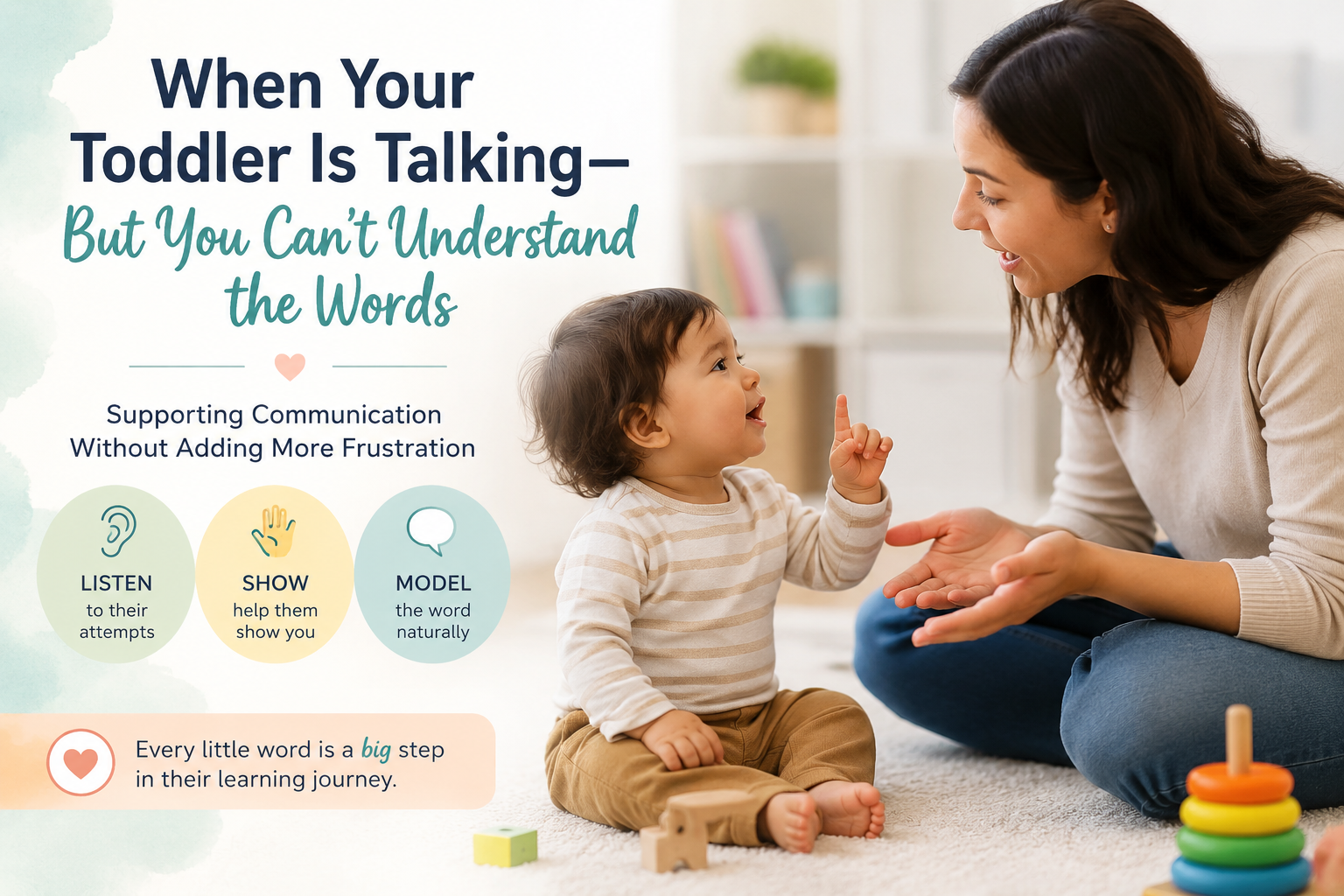
When Your Toddler Is Talking—But You Can’t Understand the Words
Supporting Communication Without Adding More Frustration
There is an exciting stage in toddler development when new words seem to appear almost every day. One moment your child is using a handful of familiar words, and suddenly they’re attempting phrases, expressing opinions, making requests, and discovering that language gives them a powerful new way to communicate.
It’s wonderful to watch—but it can also be frustrating for everyone involved.
Your toddler may know exactly what they want to tell you, repeat it several times, and become increasingly upset when you still don’t understand. To the parent, several developing words may sound almost identical. To the child, however, they may feel like they’re communicating perfectly clearly.
This gap between what a young child wants to communicate and what others can understand can create some difficult moments. The good news is that parents can support communication even when they don’t understand every word.
Communication Is Bigger Than Perfect Pronunciation
During early language development, children are still learning how to coordinate the sounds needed to produce words clearly. Their version of a word may sound very different from the adult version—and similar words can sometimes sound almost identical.
Instead of focusing only on pronunciation, pay attention to the entire message.
What is your child looking at?
What are they pointing toward?
What were they doing immediately before speaking?
Are they using a familiar gesture?
The situation surrounding the word can often provide important clues about what your child is trying to communicate.
Show Them That You’re Listening
When you don’t understand your child, try not to simply say, “I don’t know what you’re saying.”
Instead, acknowledge the communication attempt:
“I know you’re trying to tell me something.”
Then help your child show you what they mean.
You might say:
“Can you point to it?”
or:
“Can you show me?”
Giving children another way to communicate can reduce frustration while still reinforcing the importance of their words.
Use Gestures as a Bridge to Language
Gestures don’t have to disappear when children begin talking. Pointing, simple signs, facial expressions, and body movements can continue supporting spoken language while pronunciation develops.
For example, if your child says a word you don’t understand, asking them to point or show you can give you the context you need.
Once you understand, you can naturally model the word:
“Oh! You want me to open it. Let’s open it.”
There’s no need to turn every interaction into a correction. Simply hearing the correct word connected to the object or action gives your child another opportunity to learn.
When Frustration Takes Over
Imagine knowing exactly what you want but not yet having the ability to communicate it clearly. That can be incredibly frustrating for a young child.
When emotions rise, communication often becomes even harder.
In these moments, focus first on connection. Acknowledge what is happening:
“You’re frustrated because I’m having trouble understanding.”
Then offer another route:
“Let’s figure it out together. Can you show me?”
You’re helping your child learn an important lesson: When communication is difficult, there are other ways to keep trying.
Resist the Pressure to Guess Everything
Parents naturally want to solve the problem immediately, but sometimes you simply won’t figure out what your child is saying.
That’s okay.
You can still show your child that their attempt mattered:
“I’m sorry I didn’t understand that one. I really tried. We’ll keep working on it together.”
The goal isn’t for parents to decode every developing word. The goal is to create an environment where children feel encouraged to continue communicating.
Try This Today
The next time your child says something you don’t understand, try this simple three-step approach:
Listen. Show. Model.
Listen carefully to the attempt.
Ask your child to show or point to what they mean.
Once you understand, model the word naturally in your response.
“Oh, you want your bubbles! Here are the bubbles.”
One small interaction like this can support communication while helping both parent and child move through the moment with less frustration.
A Little Step Reflection
A child’s first words don’t have to sound perfect to have meaning. Behind every developing sound is a child discovering that their thoughts, wants, and ideas can be shared with another person. Sometimes the most important response isn’t understanding every word—it’s showing them that we’re still listening.
When You Have Concerns
Children develop communication skills at different rates, and unclear speech can be part of early language development. However, if you’re concerned about your child’s ability to communicate, understand language, hear clearly, or make progress over time, consider discussing those concerns with your child’s pediatrician or a qualified speech-language professional. They can provide guidance based on your individual child.
Let’s Keep Growing Together
Every child develops one little step at a time—and every parent deserves support along the way.
Join the Little Step Framework Community for practical parenting tips, new activities, developmental insights, and encouragement as your child continues to grow.
Because every big milestone begins with one little step.