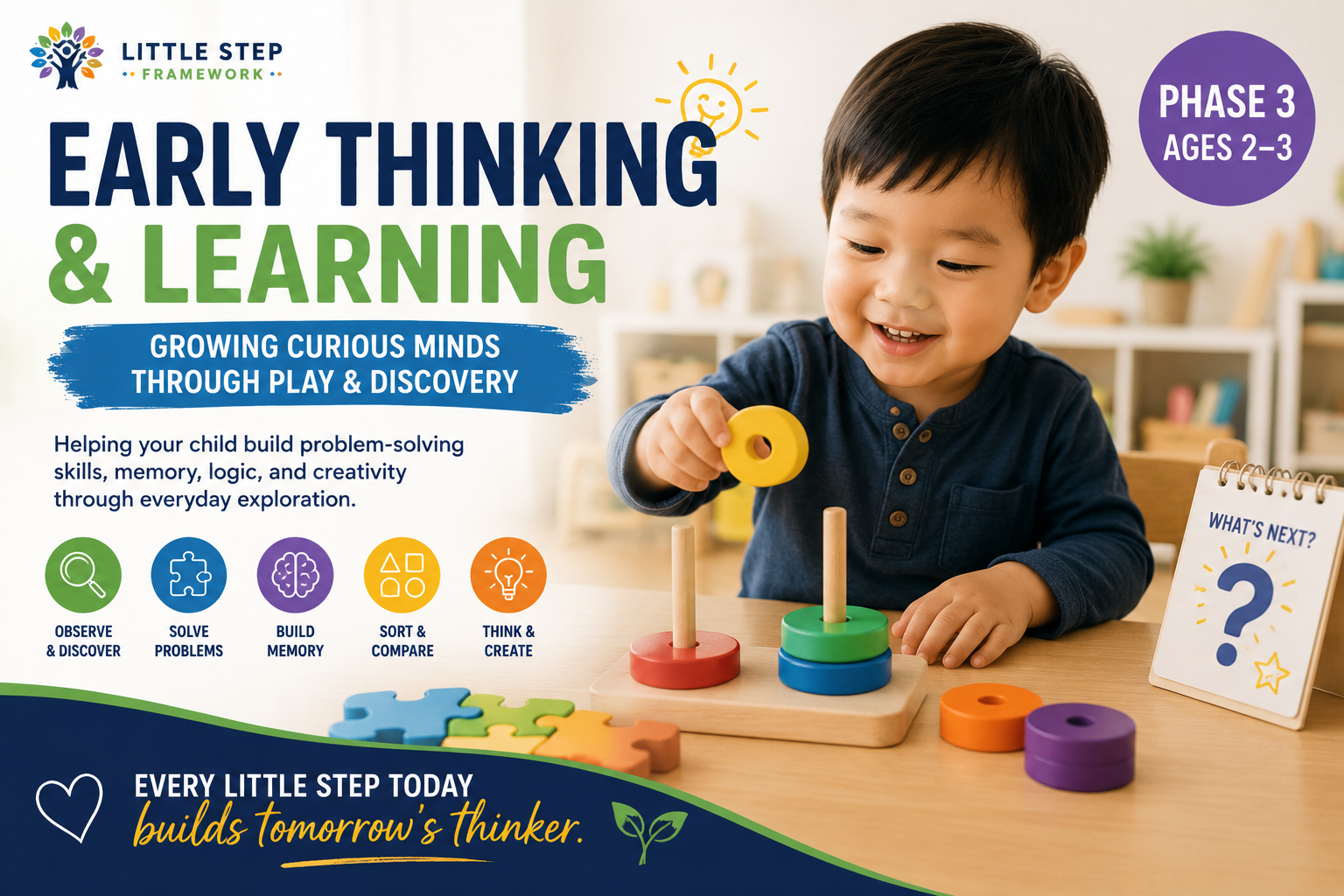
Early Thinking & Learning
Helping Your Child Become a Curious Problem Solver
Between 2 and 3 years of age, your child’s brain is growing at an incredible pace. Every question they ask, every puzzle they attempt, every object they sort, and every challenge they explore helps strengthen the thinking skills they will use throughout life.
Early Thinking & Learning is about much more than knowing the right answer. It’s about helping children observe, compare, remember, solve problems, and discover how things work.
These early experiences become the foundation for critical thinking, creativity, and lifelong learning.
Why Early Thinking Matters
Young children are natural scientists.
They love asking questions.
They enjoy experimenting.
They want to figure things out.
Whether they’re stacking blocks, fitting puzzle pieces together, sorting toys, or exploring nature, they are constantly learning how the world works.
Every successful discovery strengthens their confidence to keep learning.
Learning Through Exploration
Children learn best when they are encouraged to explore.
They don’t need every answer immediately.
Instead, they benefit from opportunities to think, observe, and try different solutions.
Simple experiences such as:
- Matching objects
- Sorting by color or size
- Completing simple puzzles
- Building towers
- Looking for hidden objects
- Comparing two items
all strengthen early thinking skills.
The goal isn’t perfection.
The goal is discovery.
Encourage Problem Solving
It’s natural to want to help your child the moment they become frustrated.
Sometimes, however, the greatest learning happens when children are given a little time to think.
If a puzzle piece doesn’t fit…
If the tower falls…
If they can’t find a toy…
Pause before stepping in.
Offer encouragement like:
“Let’s see if there’s another way.”
“What do you notice?”
“Can you try again?”
These simple prompts teach children that challenges can be solved through patience and persistence.
Build Memory Through Everyday Play
Memory develops naturally through repetition.
Reading favorite books…
Repeating songs…
Playing matching games…
Remembering where toys belong…
Following simple routines…
These activities strengthen your child’s ability to remember information and apply it in new situations.
Learning becomes stronger every time the brain makes another connection.
Celebrate Curiosity
Questions are signs of learning.
When your child asks:
“Why?”
“What happened?”
“Where did it go?”
They’re not simply asking for answers.
They’re learning how to think.
Take time to explore their questions together.
Sometimes discovering the answer is even more valuable than simply hearing it.
Every Child Thinks Differently
Some children enjoy puzzles.
Others love building.
Some ask endless questions.
Others quietly observe before trying something new.
Every thinking style is valuable.
Your role isn’t to shape your child into one type of learner.
It’s to encourage curiosity, confidence, and a willingness to keep exploring.
Try This Today
Create a simple “thinking challenge.”
Hide a favorite toy and give your child clues.
Sort buttons or blocks by color.
Ask them which object is bigger or smaller.
Build a tower together and see how high it can go before it falls.
Keep the activity playful, encouraging, and pressure-free.
Remember, every challenge your child explores helps strengthen the thinking skills they’ll use for a lifetime.
🌱 Growing Thinkers, One Little Step at a Time
Every puzzle completed…
Every question asked…
Every problem solved…
And every new discovery…
Helps build a confident, curious learner.
The Little Step Framework encourages children to think, explore, and discover—because today’s small moments of curiosity become tomorrow’s lifelong love of learning.