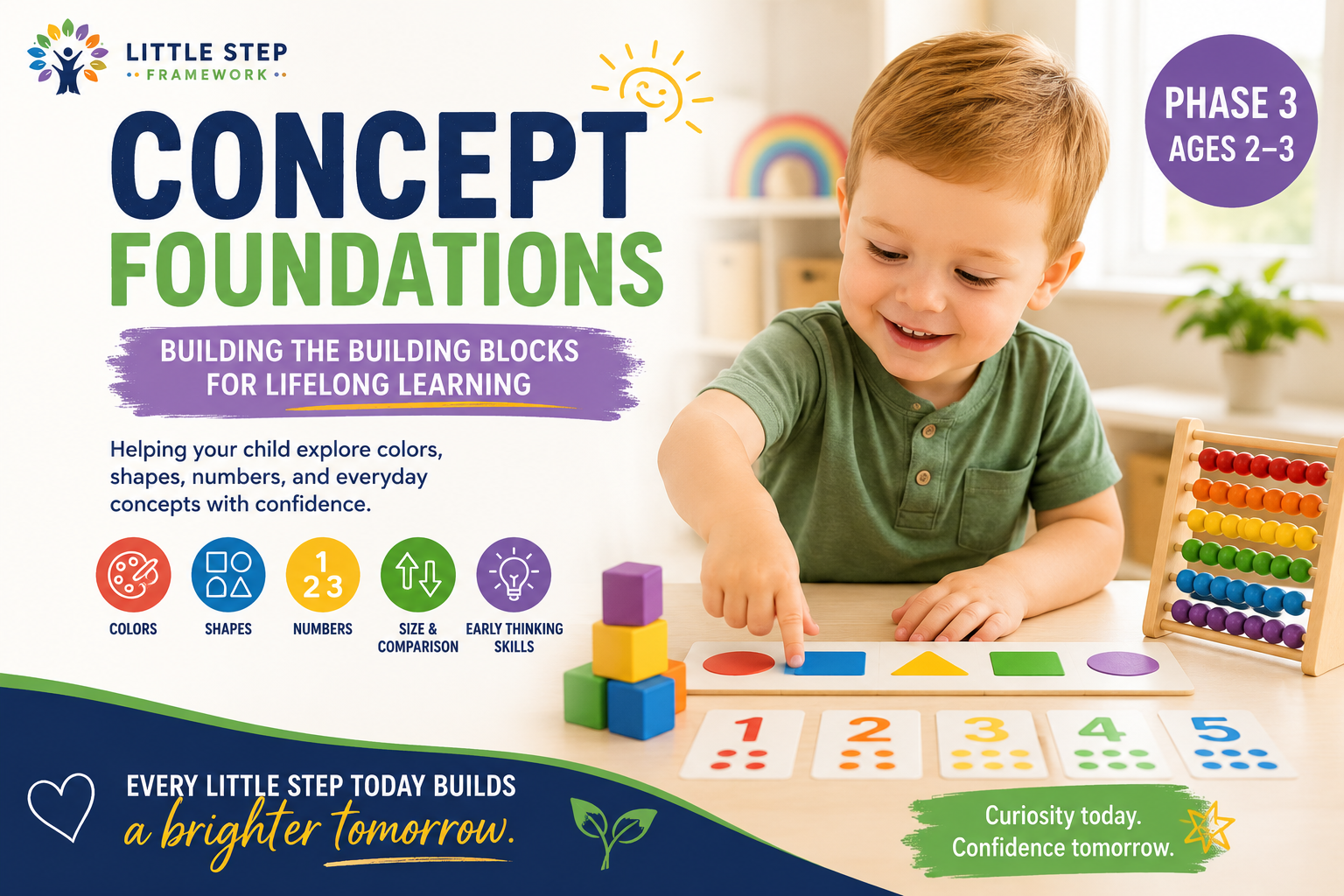
Concept Foundations
Building the Building Blocks for Lifelong Learning
Between 2 and 3 years of age, children begin making important connections that help them understand the world around them. Colors become more than colors. Shapes begin appearing everywhere. Numbers start to represent quantity. Simple concepts like big and small, near and far, or fast and slow begin making sense.
These early ideas are called concept foundations because they provide the building blocks for future learning.
Children don’t develop these skills through memorization alone. They learn by seeing, touching, sorting, comparing, moving, and experiencing the world around them every day.
Every conversation, every game, and every moment of exploration helps strengthen these important foundations.
Why Concept Foundations Matter
Concepts help children organize information.
When your child learns to recognize colors…
Identify shapes…
Count objects…
Compare sizes…
Or understand simple opposites…
They are building thinking skills that will support reading, mathematics, science, and problem-solving throughout their education.
The goal isn’t simply knowing the answers.
The goal is learning how to think about the world.
Learning Happens Everywhere
The best classroom is often everyday life.
While grocery shopping…
Count the apples.
While folding laundry…
Sort clothes by color.
During bath time…
Talk about full and empty.
At the playground…
Compare who is taller, who is faster, or which slide is bigger.
Simple conversations like these naturally introduce important concepts without making learning feel like work.
Children remember experiences far more than lessons.
Build Concepts Through Play
Play gives children countless opportunities to strengthen their understanding.
Building with blocks…
Sorting objects…
Matching pictures…
Stacking cups…
Playing with shape sorters…
Completing simple puzzles…
These playful experiences encourage children to observe, compare, predict, and discover patterns.
Every activity helps create stronger connections within the developing brain.
Ask Questions Together
Children become better thinkers when they are encouraged to observe and explain.
Instead of giving every answer, try asking questions such as:
“Which block is bigger?”
“Can you find another circle?”
“What color is your shirt?”
“How many cars do you see?”
“Which one is heavier?”
Simple questions encourage curiosity while helping children connect ideas through everyday experiences.
Celebrate Curiosity
Children naturally ask questions because they are trying to understand how the world works.
Sometimes the answer matters less than the conversation itself.
When your child asks, “Why?”
Take time to explore the answer together.
Curiosity is one of the greatest gifts you can encourage during this stage.
Every question becomes another opportunity for learning.
Every Child Learns at Their Own Pace
Some children quickly recognize colors.
Others become fascinated with numbers.
Some enjoy sorting objects, while others prefer building or exploring shapes.
Every child develops concept knowledge differently.
The goal isn’t to master everything at once.
The goal is to create consistent opportunities for discovery while celebrating each new understanding along the way.
Try This Today
Choose one concept to focus on during your daily routine.
Practice identifying colors during a walk.
Count steps as you climb the stairs.
Sort toys before cleanup.
Talk about shapes while reading a book.
Keep the activity playful, encouraging, and fun.
Remember, children don’t build strong foundations through pressure—they build them through meaningful experiences repeated one little step at a time.
🌱 A Strong Foundation Begins Today
Every color your child recognizes…
Every shape they identify…
Every number they count…
And every new idea they understand…
Becomes another building block for lifelong learning.
Small moments of curiosity today create confident learners tomorrow