
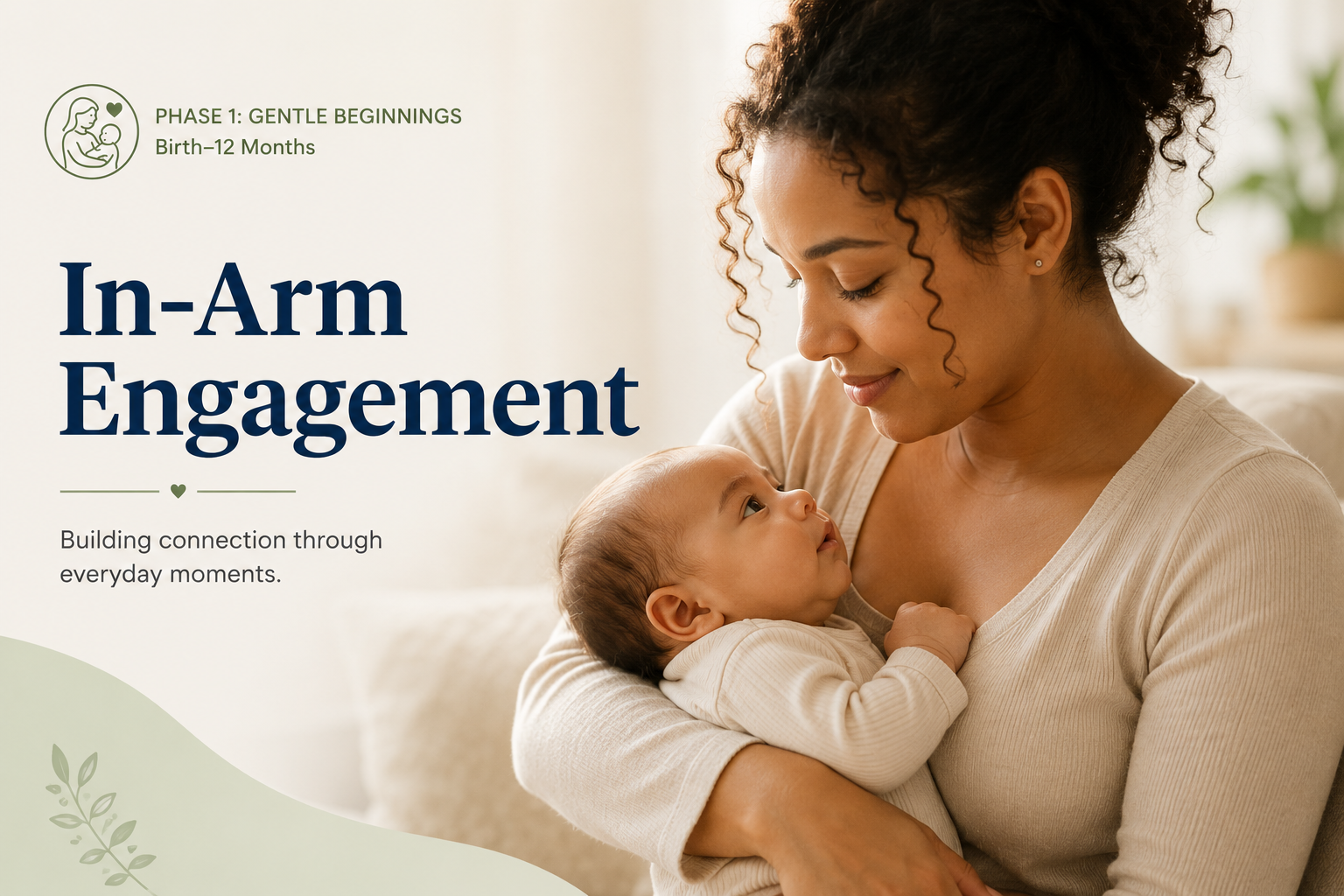
In-Arm Engagement: Your Baby’s First Learning Environment
Phase 1 – Gentle Beginnings (Birth–12 Months)
From the moment your baby is born, one of the most powerful places for learning isn’t a toy, a swing, or a play mat—it’s your arms.
Holding your baby provides far more than comfort. It creates opportunities for connection, communication, emotional security, and early learning that become the foundation for future development.
At the Little Step Framework, we call these intentional moments In-Arm Engagement.
What Is In-Arm Engagement?
In-Arm Engagement is the intentional interaction that takes place while your baby is safely held against your chest or shoulder.
Instead of simply carrying your baby from one place to another, these everyday moments become opportunities to build trust, encourage communication, and support healthy development through calm, loving interaction.
Whether you’re feeding your baby, comforting them, or simply enjoying a quiet moment together, every interaction has the potential to strengthen your relationship.
Why In-Arm Engagement Matters
During the first year of life, babies learn through relationships.
Your face, your voice, your touch, and your movements all provide important information that helps your baby begin understanding the world.
Simple interactions while holding your baby help support:
- Emotional bonding and secure attachment.
- Early attention and engagement.
- Recognition of familiar voices and faces.
- Beginning communication through facial expressions and sounds.
- A sense of comfort, safety, and trust.
These experiences don’t require extra time in your day—they simply require intention during the moments you’re already sharing.
How to Practice In-Arm Engagement
Begin by holding your baby comfortably while fully supporting their head and neck.
During calm, alert moments:
- Make gentle eye contact if your baby is interested.
- Speak softly or sing a familiar song.
- Smile and allow your baby to observe your face.
- Add one simple interaction at a time, such as gentle humming or allowing your baby to follow your face.
- Spend about 20–40 seconds engaging before taking a natural pause.
These short interactions can be repeated naturally throughout the day during feeding, diaper changes, comforting, or quiet cuddle time.
Watch Your Baby’s Cues
Every baby communicates differently.
Some babies will eagerly watch your face and enjoy interaction.
Others may briefly look away, close their eyes, or become fussy when they’ve had enough.
When your baby turns away or becomes overstimulated, simply pause and try again later.
Following your baby’s cues helps create positive experiences built on trust rather than pressure.
What to Avoid
During In-Arm Engagement, avoid:
- Shaking or bouncing your baby quickly.
- Loud or overstimulating sounds.
- Trying to hold your baby’s attention for too long.
- Forcing eye contact when your baby looks away.
The goal is not constant stimulation.
The goal is creating calm, meaningful moments of connection.
Every Moment Counts
Parents sometimes wonder if they need special equipment or long teaching sessions to support early development.
The answer is no.
Your voice, your smile, your touch, and your presence are some of the most valuable developmental tools your baby will experience during the first year.
Small moments repeated consistently throughout the day can have a lasting impact.
Try This Today
The next time you hold your baby after a feeding or during a quiet moment, spend just 30 seconds smiling, speaking softly, or gently humming while allowing your baby to observe your face.
Don’t worry about doing it perfectly.
Simply enjoy the moment together.
Your Next Little Step
In-Arm Engagement is the first of the six Core Elements in Phase 1 – Gentle Beginnings.
As your baby becomes more alert and engaged, continue your journey by exploring the next Core Element: Visual Stimulation.
Or, if you haven’t already, take the FREE Phase 1 Development Snapshot to discover personalized guidance and identify your baby’s next Little Step.